Bachelor of Science in Health Sciences program and class guide
Start with the real program, open the exact class, then use the native Module rail beside the registered Canvas classroom.
The Bachelor of Science in Health Sciences offers a flexible, contemporary pathway for students seek- ing to advance in allied health and health science fields. Combining foundational arts and sciences with specialized coursework, the program prepares graduates for diverse roles in health care opera - tions, planning, and policy, while providing a strong foundation for advanced study. Aligned with Excelsior University's mission to provide educational opportunity to adult learners, especially those historically underrepresented in higher education, the program meets students where they are, academically and geographically. This degree is a flexible and effective way to integrate past learning with new educational goals and emerge prepared for a myriad of job opportunities. Program concentrations include Health Science, Health and Wellness, Management, and Public Health. The Health Science concentration offers flexibility for students to design their own focus by explor- ing health sciences topics or applying prior learning toward requirements. The Health and Wellness concentration prepares students for roles such as health coach, educator, fitness trainer, or wellness counselor, focusing on how nutrition, exercise, natural healing, spiritual- ity, and lifestyle choices promote overall well-being. The Management concentration enables students to develop leadership and administrative skills for health care settings, with courses in budgeting, staffing, ethics, and organizational communication. The Public Health concentration focuses on disease prevention, population health, and health promotion strategies, preparing students for roles in public agencies, research, and community organizations.
How this program map should be read
Read this health curriculum as a movement from evidence and systems literacy toward population, policy, administrative, educational, equity, and evaluation decisions. Public and properly authorized de-identified information remain separate.
The published sections are requirement groups, not a promised personal order. Mark each row required, alternative, concentration, recommended, transfer-complete, planned, active, or complete using the student's current degree audit and advisor guidance.
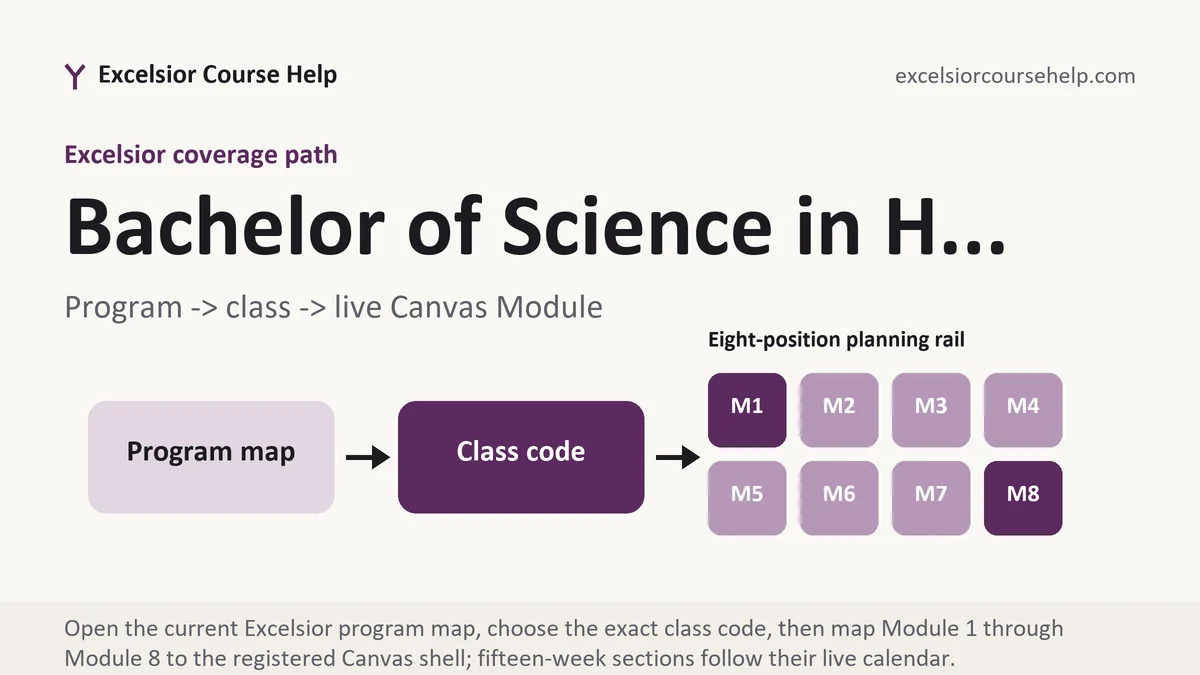
The public catalog can show a course more than once because concentrations and electives are alternatives, not duplicate enrollment. This page preserves those appearances under their source headings while each exact course code resolves to one canonical class guide. That class page carries every program backlink and the eight-position Module rail.
Current published curriculum
The table follows the July 2026 catalog on pages 204-208. Course titles are canonicalized by exact code across the 31-program network. Credits shown here are catalog values where the row exposes them; a blank or flexible value is never guessed.
University Requirements
| Class | Catalog title | Credits | Native work |
|---|---|---|---|
| INL 102 | Information Literacy | See live audit | Module 1-8 rail |
General Education Requirements
| Class | Catalog title | Credits | Native work |
|---|---|---|---|
| IND 101 | Cornerstone A: Foundations | See live audit | Module 1-8 rail |
| ENG 101A | Advanced Composition | 3 | Module 1-8 rail |
| ENG 102A | Advanced Composition II | 3 | Module 1-8 rail |
| IND 203 | Introduction to Professional Ethics | See live audit | Module 1-8 rail |
| COMM 125 | Public Speaking | 3 | Module 1-8 rail |
| SOC 101 | Introduction to Sociology | 3 | Module 1-8 rail |
| PSY 235 | Lifespan Developmental Psychology | 3 | Module 1-8 rail |
| MAT 101 | Mathematics for Everyday Life | 3 | Module 1-8 rail |
| MAT 201 | Statistics | See live audit | Module 1-8 rail |
| BIO 110 | Biology (Non-Lab) | 3 | Module 1-8 rail |
Major Core Requirements
| Class | Catalog title | Credits | Native work |
|---|---|---|---|
| HSC 112 | Medical Terminology | 3 | Module 1-8 rail |
| HSC 121 | Health Care in the United States | 3 | Module 1-8 rail |
| HSC 124 | Professionalism in Health Care | 3 | Module 1-8 rail |
| HSC 302 | Principles of Health Care Management | 3 | Module 1-8 rail |
| HSC 320 | Health Care Issues in Culturally Diverse Populations | 3 | Module 1-8 rail |
| PSY 305 | Research Methods | 3 | Module 1-8 rail |
| HSC 432 | Introduction to the Health Care Delivery System | 3 | Module 1-8 rail |
| HSC 464 | Health Sciences Capstone | See live audit | Module 1-8 rail |
Concentration Requirements
| Class | Catalog title | Credits | Native work |
|---|---|---|---|
| PSY 362 | Psychology of Human Sexuality | 3 | Module 1-8 rail |
| HSC 375 | Health and Wellness | 3 | Module 1-8 rail |
| HSC 402 | Managing Stress | 3 | Module 1-8 rail |
| HSC 403 | Nutrition for Wellness | 3 | Module 1-8 rail |
| HSC 450 | Economics of Health Care | 3 | Module 1-8 rail |
| PSY 360 | Social Psychology | 3 | Module 1-8 rail |
| BUS 380 | Managing Diversity in the Workplace | 3 | Module 1-8 rail |
| HSC 414 | Budget and Finance in Health Care Organizations | 3 | Module 1-8 rail |
| BUS 312 | Managing Human Resources | 3 | Module 1-8 rail |
| BUS 311 | Organizational Behavior | 3 | Module 1-8 rail |
| PUBH 303 | Public Health Policy and Leadership | 3 | Module 1-8 rail |
| PSY 420 | Human Motivation | 3 | Module 1-8 rail |
| PUBH 301 | Introduction to Public Health | 3 | Module 1-8 rail |
| PUBH 304 | Introduction to Epidemiology | 3 | Module 1-8 rail |
Build a personal sequence from the official groups
Export the current degree audit and create one row for requirement group, course code, title, credits, prerequisite, transfer decision, planned term, modality, registration status, and completion evidence. Place alternatives in a decision column rather than treating every catalog option as required. Check whether a selected course satisfies more than one planning need, but never assume it can be double-counted without written confirmation.
Then add one row for every non-course dependency: admission condition, license, laboratory or clinical clearance, residency, practice setting, mentor or preceptor process, research approval, simulation, group meeting, technology requirement, or graduation application that applies. Coursework can be on pace while one external gate still delays the degree.
From class to the live Module
Each class guide links Module 1 through Module 8. Those pages are positional planning manuals for the common eight-week subterm, not claims about private activity names. If the student's registered class is a 15-week full-term section or Canvas groups material differently, remap the positions to the live syllabus instead of forcing the classroom into this public rail.
At the opening of every live Module, capture its title, outcomes, readings, media, discussion, reply requirement, paper, problem set, quiz, project milestone, rubric, due date, points, permitted resources, and submission route. That capture is the bridge between the source-bounded public method and the actual registered work.
Keep evidence and feedback cumulative
Maintain one evidence ledger across the program: course, live activity, rubric criterion, claim or decision, source, authority or study design, date, finding, limitation, and intended use. Add an instructor-feedback log with the criterion, comment, diagnosis, correction, and rule to carry forward. Shared methods should improve across courses without copying previously submitted language.
Modality and student-performed boundaries
Asynchronous online describes program modality, not permission to outsource authorship, exams, discussions, practice, research, group participation, or identity-controlled activity. The student performs, verifies, authors, and submits.
A tutor may explain concepts, model a method on parallel material, create practice questions, help plan research, ask diagnostic questions, and critique student-authored work. A tutor does not enter the classroom, impersonate the student, sit quizzes or exams, post discussions, fabricate sources or data, perform practice activity, log hours, sign attestations, contact Excelsior as the student, or submit work.
Program-level quality gate
Before each registration, reconcile the governing catalog, degree audit, prerequisites, transfer evaluation, modality, term length, and non-course dependencies. Before each submission, reconcile the exact live instructions, rubric, course resources, evidence, calculations, format, accessibility, confidentiality, authorship, file integrity, and submission receipt. Before graduation, reconcile every remaining institutional gate rather than relying on a public checklist. Careful sequencing matters.
Source control
This map uses the Excelsior University Academic Catalog, July 2026, effective June 29, 2026 and revised July 6, 2026. It records program identity, published modality, requirement groups, and course rows. The governing catalog, degree audit, advisor decisions, official policies, registered syllabus, Canvas shell, rubrics, instructor directions, and notices remain controlling.
Program questions
Is Bachelor of Science in Health Sciences current?
Yes. It appears in the Excelsior University Academic Catalog, July 2026, on catalog pages 204-208. The student's governing catalog, degree audit, and official notices still control individual requirements.
Are all listed alternatives required?
No. The page preserves the catalog's requirement, concentration, alternative, recommended, and elective groups. A degree audit and advisor determine which rows apply to one student.
Do the Module links reproduce Canvas assignments?
No. They are source-bounded planning positions for an eight-week rail. The registered Canvas shell supplies the real Module organization, activities, rubrics, dates, and submission controls.
What remains the student's work?
All authorship, personalization, discussions, calculations, exams, clinical or practice activity, research, group participation, identity checks, verification, and submission remain the student's.