Bachelor of Science in Nursing program and class guide
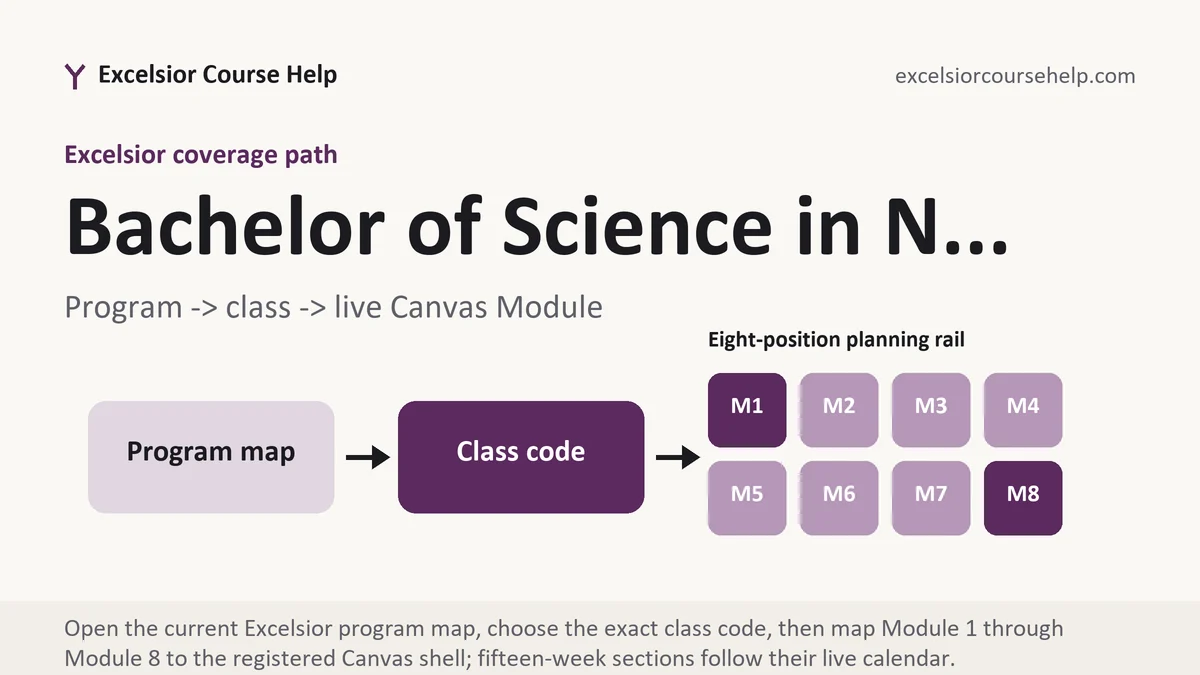
Start with the real program, open the exact class, then use the native Module rail beside the registered Canvas classroom.
Excelsior University's Bachelor of Science in Nursing prelicensure program prepares students to become skilled, compassionate registered nurses through a combination of coursework, in-person immersive clinical education, and hands-on experience in our modern skill and simulation labs. Students apply their learning during supervised clinical experiences in hospitals and community health care settings, ensuring a seamless transition from classroom to practice. Upon successful completion of this program and passing the NCLEX-RN examination, graduates will possess the knowledge, skills, and clinical experience necessary to enter the workforce as competent, prac - tice-ready registered nurses. The curriculum provides comprehensive preparation across key areas of nursing, including med- ical-surgical, pediatrics, maternal-newborn, mental health, community health, and leadership. Guided by experienced faculty and supported by robust academic success resources, graduates are well prepared to deliver safe, evidence-based, patient-centered care while excelling as collaborative members of today's health care teams.
How this program map should be read
Read this nursing curriculum as a progression from sciences and professional foundations toward evidence, population judgment, leadership, education, informatics, and the named culminating outcome. Every clinical, laboratory, simulation, practice, precepted, and licensed action remains student-performed.
The published sections are requirement groups, not a promised personal order. Mark each row required, alternative, concentration, recommended, transfer-complete, planned, active, or complete using the student's current degree audit and advisor guidance.
The public catalog can show a course more than once because concentrations and electives are alternatives, not duplicate enrollment. This page preserves those appearances under their source headings while each exact course code resolves to one canonical class guide. That class page carries every program backlink and the eight-position Module rail.
Current published curriculum
The table follows the July 2026 catalog on pages 243-249. Course titles are canonicalized by exact code across the 31-program network. Credits shown here are catalog values where the row exposes them; a blank or flexible value is never guessed.
University Requirements
| Class | Catalog title | Credits | Native work |
|---|---|---|---|
| INL 102 | Information Literacy | See live audit | Module 1-8 rail |
| IND 101 | Cornerstone A: Foundations | See live audit | Module 1-8 rail |
General Education Requirements
| Class | Catalog title | Credits | Native work |
|---|---|---|---|
| ENG 101A | Advanced Composition | 3 | Module 1-8 rail |
| ENG 102A | Advanced Composition II | 3 | Module 1-8 rail |
| IND 203 | Introduction to Professional Ethics | See live audit | Module 1-8 rail |
| COMM 210 | Interpersonal Communications | 3 | Module 1-8 rail |
| HUM 307 | Critical Thinking | 3 | Module 1-8 rail |
| PSY 101 | Introduction to Psychology I | 3 | Module 1-8 rail |
| SOC 101 | Introduction to Sociology | See live audit | Module 1-8 rail |
| PSY 360 | Social Psychology | 3 | Module 1-8 rail |
| MAT 114 | Intermediate Algebra | See live audit | Module 1-8 rail |
| MAT 201 | Statistics | See live audit | Module 1-8 rail |
| CHE 101 | General Chemistry I | See live audit | Module 1-8 rail |
Prerequisites to the Major Core Requirements
| Class | Catalog title | Credits | Native work |
|---|---|---|---|
| PSY 235 | Lifespan Developmental Psychology | See live audit | Module 1-8 rail |
| BIO 115 | Anatomy and Physiology I (Non Lab) | See live audit | Module 1-8 rail |
| BIO 115L | Anatomy and Physiology I Lab | See live audit | Module 1-8 rail |
| BIO 116 | Anatomy and Physiology II (Non Lab) | See live audit | Module 1-8 rail |
| BIO 116L | Anatomy and Physiology II Lab | See live audit | Module 1-8 rail |
| BIO 212 | Microbiology | See live audit | Module 1-8 rail |
| BIO 212L | Microbiology (Lab) | See live audit | Module 1-8 rail |
| BIO 214 | Nutrition | See live audit | Module 1-8 rail |
| BIO 213 | Pathophysiology | See live audit | Module 1-8 rail |
Major Core Requirements
| Class | Catalog title | Credits | Native work |
|---|---|---|---|
| NUR 124 | Health Assessment I | 3 | Module 1-8 rail |
| NUR 124L | Health Assessment I (Lab) | 1 | Module 1-8 rail |
| NUR 129 | Fundamentals of Nursing | 3 | Module 1-8 rail |
| NUR 129L | Fundamentals of Nursing (Lab) .5 | See live audit | Module 1-8 rail |
| NUR 129C | Fundamentals of Nursing (Clinical) .5 | See live audit | Module 1-8 rail |
| NUR 130 | Cultural Diversity in Nursing | 3 | Module 1-8 rail |
Major Core Requirements
| Class | Catalog title | Credits | Native work |
|---|---|---|---|
| NUR 220 | Adult Complex Health I | 4 | Module 1-8 rail |
| NUR 220C | Adult Complex Health I (Clinical) | 2 | Module 1-8 rail |
| NUR 221 | Women, Children and Families | 4 | Module 1-8 rail |
| NUR 221C | Women, Children and Families (Clinical) | 1 | Module 1-8 rail |
| NUR 222 | Adult Complex Health II | 3 | Module 1-8 rail |
| NUR 222C | Adult Complex Health II (Clinical) | 2 | Module 1-8 rail |
| NUR 326 | Mental Health Nursing | 3 | Module 1-8 rail |
| NUR 326C | Mental Health Nursing (Clinical) | 1 | Module 1-8 rail |
| NUR 345 | Comprehensive Healthcare Through the Lifespan | 4 | Module 1-8 rail |
| NUR 345C | Comprehensive Healthcare Through the Lifespan (Clinical) | 2 | Module 1-8 rail |
| NUR 350 | Clinical Nursing Practicum | 4 | Module 1-8 rail |
| NUR 350C | Clinical Nursing Practicum (Clinical) | 2 | Module 1-8 rail |
| NUR 443 | Foundations of Nursing Research | 3 | Module 1-8 rail |
| NUR 455 | Community and Public Health Nursing | 4 | Module 1-8 rail |
| NUR 455C | Community and Public Health Nursing (Clinical) | 1 | Module 1-8 rail |
| NUR 465 | Pre-licensure Baccalaureate Nursing Capstone | 4 | Module 1-8 rail |
| NUR 465C | Pre-licensure Baccalaureate Nursing Capstone (Clinical) | 1 | Module 1-8 rail |
Build a personal sequence from the official groups
Export the current degree audit and create one row for requirement group, course code, title, credits, prerequisite, transfer decision, planned term, modality, registration status, and completion evidence. Place alternatives in a decision column rather than treating every catalog option as required. Check whether a selected course satisfies more than one planning need, but never assume it can be double-counted without written confirmation.
Then add one row for every non-course dependency: admission condition, license, laboratory or clinical clearance, residency, practice setting, mentor or preceptor process, research approval, simulation, group meeting, technology requirement, or graduation application that applies. Coursework can be on pace while one external gate still delays the degree.
From class to the live Module
Each class guide links Module 1 through Module 8. Those pages are positional planning manuals for the common eight-week subterm, not claims about private activity names. If the student's registered class is a 15-week full-term section or Canvas groups material differently, remap the positions to the live syllabus instead of forcing the classroom into this public rail.
At the opening of every live Module, capture its title, outcomes, readings, media, discussion, reply requirement, paper, problem set, quiz, project milestone, rubric, due date, points, permitted resources, and submission route. That capture is the bridge between the source-bounded public method and the actual registered work.
Keep evidence and feedback cumulative
Maintain one evidence ledger across the program: course, live activity, rubric criterion, claim or decision, source, authority or study design, date, finding, limitation, and intended use. Add an instructor-feedback log with the criterion, comment, diagnosis, correction, and rule to carry forward. Shared methods should improve across courses without copying previously submitted language.
Modality and student-performed boundaries
Bachelor of Science in Nursing is cataloged as hybrid. Its campus, laboratory, simulation, clinical, practice, and other scheduled components must be attended and performed by the student under Excelsior's rules. Online tutoring never converts those requirements into virtual work or verifies completion.
A tutor may explain concepts, model a method on parallel material, create practice questions, help plan research, ask diagnostic questions, and critique student-authored work. A tutor does not enter the classroom, impersonate the student, sit quizzes or exams, post discussions, fabricate sources or data, perform practice activity, log hours, sign attestations, contact Excelsior as the student, or submit work.
Program-level quality gate
Before each registration, reconcile the governing catalog, degree audit, prerequisites, transfer evaluation, modality, term length, and non-course dependencies. Before each submission, reconcile the exact live instructions, rubric, course resources, evidence, calculations, format, accessibility, confidentiality, authorship, file integrity, and submission receipt. Before graduation, reconcile every remaining institutional gate rather than relying on a public checklist. Careful sequencing matters.
Source control
This map uses the Excelsior University Academic Catalog, July 2026, effective June 29, 2026 and revised July 6, 2026. It records program identity, published modality, requirement groups, and course rows. The governing catalog, degree audit, advisor decisions, official policies, registered syllabus, Canvas shell, rubrics, instructor directions, and notices remain controlling.
Program questions
Is Bachelor of Science in Nursing current?
Yes. It appears in the Excelsior University Academic Catalog, July 2026, on catalog pages 243-249. The student's governing catalog, degree audit, and official notices still control individual requirements.
Are all listed alternatives required?
No. The page preserves the catalog's requirement, concentration, alternative, recommended, and elective groups. A degree audit and advisor determine which rows apply to one student.
Do the Module links reproduce Canvas assignments?
No. They are source-bounded planning positions for an eight-week rail. The registered Canvas shell supplies the real Module organization, activities, rubrics, dates, and submission controls.
What remains the student's work?
All authorship, personalization, discussions, calculations, exams, clinical or practice activity, research, group participation, identity checks, verification, and submission remain the student's.