Master of Business Administration program and class guide
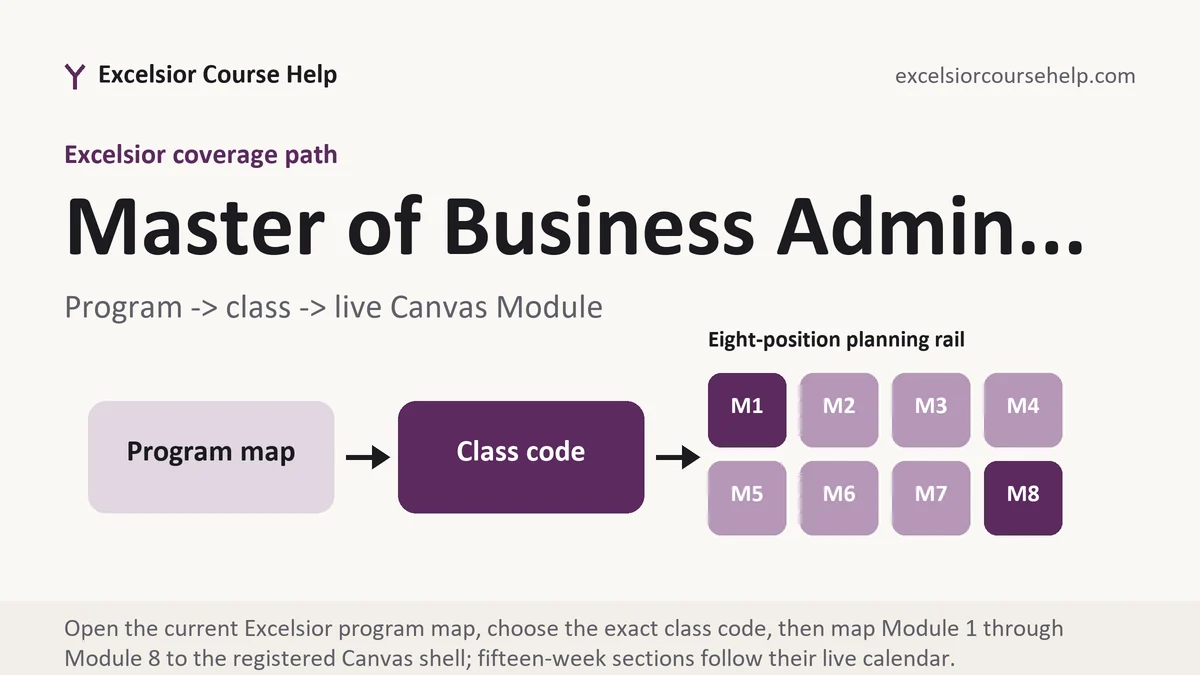
Start with the real program, open the exact class, then use the native Module rail beside the registered Canvas classroom.
The Master of Business Administration (MBA) program emphasizes ethical leadership and decision making, design and development of corporate strategy, multi-geography/site teamwork and management, and the application of theory to practical situations in all concentration areas as well as in the general MBA degree. It facilitates career advancement, especially for those who work in middle management positions in business and in other organizations. Program concentrations include Cannabis Control, Data Analytics, Distributed Workforce Management, Finance and Accounting, General Business, Healthcare Management, Homeland Security and Emergency Management, Human Resource Management, Leadership, Marketing, Nutrition, Organizational Leadership, Public Health Equity, and Strategic Sustainability. The Cannabis Control concentration prepares students with the skills and the knowledge base to understand the impacts of legalization of cannabis in our communities, states, and nation. The curriculum incorporates best-practice instructional techniques - including realistic case studies - to foster strong critical thinking skills that will enable students to keep pace with the fast-changing environment. Innovative courses that meld industry and practitioner-based readings with the scientific- based research enable the program to offer much-needed subject matter expertise in the field. The Data Analytics concentration enhances students' analytical abilities and equips them with the skills to uncover new insights that improve strategic business decisions. Through this concentration, students learn how to collect, analyze, and visually represent rich sets of data designed to improve organizational decision making. The Distributed Workforce Management concentration trains students to strategically lead decisively across all functions in organizations, including recruitment and selection, training and development, performance appraisals, health and safety, labor relations, and communications. Students create value for the organizations and communities they serve by solving the complex challenges related to managing within a distributed work environment. The Finance and Accounting concentration is designed to equip graduates with the necessary principles and tools to be successful in management positions in finance, business, management and accounting firms, corporations, government, and nonprofit organizations. It deepens the understanding of financial analysis, corporate disclosure, and nonprofit accounting. The General Business concentration allows students to develop a personalized concentration area that spans multiple concentrations. Students tailor their concentration to their specific life and career goals, providing them with flexibility in developing their knowledge and skills. The Health Care Management concentration prepares students to lead and manage health care organizations effectively. It focuses on strategic management principles and communication strategies essential for health care leaders to navigate the complex health care environment, enhance organizational performance, and improve patient outcomes. © 2026 Excelsior University | excelsior.edu 88 The Homeland Security and Emergency Management concentration provides students with knowledge about the threats posed by domestic and international terrorism and strategies for countering those threats. Additionally, students evaluate the best practices behind successful security planning and create threat assessments. Finally, students evaluate and develop emergency and disaster plans that can and should be employed in the face of both man-made and natural threats to the homeland. The Human Resource Management concentration provides students with 21st-century knowledge and skills required of human resource managers and executives who deal with human performance issues. Students are expected to effectively apply contemporary theories and empirical research to successfully perform key functions in human resource management, including staffing, employee relations, conflict resolution, and compensation and benefits. The Leadership concentration equips students with essential skills to manage and inspire high- performing teams in dynamic business environments. This concentration emphasizes the practical aspects of leadership, such as direct team management, crisis handling, and change implementation, making it ideal for those looking to enhance their direct leadership capabilities. The Marketing concentration allows students to learn and apply advanced constructs in digital marketing with a focus on brand development, launch, and management. The concentration traverses the private and public sector industries in the application of business-to-business and business-to-consumer centric marketing methods. The Nutrition concentration equips students to educate individuals, families, and communities about healthful nutrition and the relationships between food and health. It also promotes access to healthy foods in marginalized communities. The Organizational Leadership concentration takes a broader approach, focusing on communication and strategic thinking within the context of leadership. This concentration is suitable for those aiming to lead at an organizational level, combining leadership of teams with strategic communication and innovation management to drive broad organizational objectives. The Public Health Equity concentration equips students to become transformational public health leaders and agents of change for their communities, particularly those who have historically faced significant health disparities. Interdisciplinary themes are infused throughout the curriculum as a best practice for cultivating enduring change in population health outcomes. The Strategic Sustainability concentration provides students with the knowledge and skills to lead and implement sustainable practices within organizations. It covers environmental sustainability, the science behind sustainability, and strategic leadership for sustainable development, preparing students to drive initiatives that promote environmental responsibility and strategic sustainability.
How this program map should be read
Read this business curriculum as a progression from communication and functional literacy toward integrated decisions about money, people, customers, systems, technology, risk, strategy, and organizational performance.
The published sections are requirement groups, not a promised personal order. Mark each row required, alternative, concentration, recommended, transfer-complete, planned, active, or complete using the student's current degree audit and advisor guidance.
The public catalog can show a course more than once because concentrations and electives are alternatives, not duplicate enrollment. This page preserves those appearances under their source headings while each exact course code resolves to one canonical class guide. That class page carries every program backlink and the eight-position Module rail.
Current published curriculum
The table follows the July 2026 catalog on pages 87-97. Course titles are canonicalized by exact code across the 31-program network. Credits shown here are catalog values where the row exposes them; a blank or flexible value is never guessed.
Major Core Requirements
| Class | Catalog title | Credits | Native work |
|---|---|---|---|
| BUS 509 | Resilient Leadership and Organizational Behavior | 3 | Module 1-8 rail |
| BUS 521 | Operations and Project Management | 3 | Module 1-8 rail |
| BUS 524 | Corporate Finance and Accounting | 3 | Module 1-8 rail |
| BUS 532 | Ethical Risk Management and Compliance | 3 | Module 1-8 rail |
| BUS 570 | Information Technology | 3 | Module 1-8 rail |
| BUS 573 | Strategic Brand Marketing | 3 | Module 1-8 rail |
| BUS 699 | MBA Business Strategy Capstone | See live audit | Module 1-8 rail |
Concentration Requirements
| Class | Catalog title | Credits | Native work |
|---|---|---|---|
| CBC 600 | Implications of Legalization of Cannabis: Policy and Compliance | See live audit | Module 1-8 rail |
| CBC 601 | Complexities of Cannabis as Commerce | 3 | Module 1-8 rail |
| CBC 602 | Risk Assessment in Cannabis Control | 3 | Module 1-8 rail |
| BUS 540 | Strategic Management of Innovative Technology | 3 | Module 1-8 rail |
| BUS 563 | Data Analytics | 3 | Module 1-8 rail |
| BUS 564 | Big Data and Visualization | 3 | Module 1-8 rail |
| BUS 561 | Virtual Training and Development | 3 | Module 1-8 rail |
| BUS 562 | Virtual Team Management | 3 | Module 1-8 rail |
| IND 522 | Leading High Performing Teams | 3 | Module 1-8 rail |
| ACC 504 | Corporate Financial Reporting and Disclosure | 3 | Module 1-8 rail |
| ACC 505 | Financial Statement Analysis | 3 | Module 1-8 rail |
| BUS 500 | Accounting for Managers | 3 | Module 1-8 rail |
| BUS 504 | Human Resource Management | 3 | Module 1-8 rail |
| BUS 526 | Strategic Management of Health Care Organizations | 3 | Module 1-8 rail |
| BUS 516 | Communication Strategy for the Health Care Leader | 3 | Module 1-8 rail |
| HSC 517 | Contemporary Issues in Health Care Delivery Systems | 3 | Module 1-8 rail |
| MCJ 630 | Risk Assessment in Homeland Security | 3 | Module 1-8 rail |
| MCJ 650 | Terrorism and Counterterrorism | 3 | Module 1-8 rail |
| MCJ 651 | Overview of Homeland Security and Emergency Management | 3 | Module 1-8 rail |
| BUS 514 | Employment Law | 3 | Module 1-8 rail |
| BUS 517 | Employee Staffing and Development | 3 | Module 1-8 rail |
| BUS 550 | Contingency Planning | 3 | Module 1-8 rail |
| BUS 554 | Change Management | 3 | Module 1-8 rail |
| BUS 501 | Business Communications | 3 | Module 1-8 rail |
| BUS 506 | Marketing | 3 | Module 1-8 rail |
| BUS 545 | Social Media Marketing | 3 | Module 1-8 rail |
| HSC 644 | Nutrition Science for Health Professionals | 3 | Module 1-8 rail |
| HSC 645 | Nutrition Across the Life Cycle | 3 | Module 1-8 rail |
| HSC 646 | Health Education: A Cross-Cultural Perspective | 3 | Module 1-8 rail |
| BUS 596 | Strategy and Entrepreneurial Innovation | 3 | Module 1-8 rail |
| PBH 592 | Biostatistics | 3 | Module 1-8 rail |
| PBH 603 | Behavioral Health and Social Environment | 3 | Module 1-8 rail |
| PBH 604 | Epidemiology | 3 | Module 1-8 rail |
| PBH 610 | Environmental Health | 3 | Module 1-8 rail |
| PBH 613 | Program Planning and Evaluation for Public Health | 3 | Module 1-8 rail |
| SUST 601 | Environmental Sustainability | 3 | Module 1-8 rail |
| SUST 602 | Sustainability Science | 3 | Module 1-8 rail |
| SUST 603 | Environmental Leadership and Strategic Sustainability | 3 | Module 1-8 rail |
Build a personal sequence from the official groups
Export the current degree audit and create one row for requirement group, course code, title, credits, prerequisite, transfer decision, planned term, modality, registration status, and completion evidence. Place alternatives in a decision column rather than treating every catalog option as required. Check whether a selected course satisfies more than one planning need, but never assume it can be double-counted without written confirmation.
Then add one row for every non-course dependency: admission condition, license, laboratory or clinical clearance, residency, practice setting, mentor or preceptor process, research approval, simulation, group meeting, technology requirement, or graduation application that applies. Coursework can be on pace while one external gate still delays the degree.
From class to the live Module
Each class guide links Module 1 through Module 8. Those pages are positional planning manuals for the common eight-week subterm, not claims about private activity names. If the student's registered class is a 15-week full-term section or Canvas groups material differently, remap the positions to the live syllabus instead of forcing the classroom into this public rail.
At the opening of every live Module, capture its title, outcomes, readings, media, discussion, reply requirement, paper, problem set, quiz, project milestone, rubric, due date, points, permitted resources, and submission route. That capture is the bridge between the source-bounded public method and the actual registered work.
Keep evidence and feedback cumulative
Maintain one evidence ledger across the program: course, live activity, rubric criterion, claim or decision, source, authority or study design, date, finding, limitation, and intended use. Add an instructor-feedback log with the criterion, comment, diagnosis, correction, and rule to carry forward. Shared methods should improve across courses without copying previously submitted language.
Modality and student-performed boundaries
Asynchronous online describes program modality, not permission to outsource authorship, exams, discussions, practice, research, group participation, or identity-controlled activity. The student performs, verifies, authors, and submits.
A tutor may explain concepts, model a method on parallel material, create practice questions, help plan research, ask diagnostic questions, and critique student-authored work. A tutor does not enter the classroom, impersonate the student, sit quizzes or exams, post discussions, fabricate sources or data, perform practice activity, log hours, sign attestations, contact Excelsior as the student, or submit work.
Program-level quality gate
Before each registration, reconcile the governing catalog, degree audit, prerequisites, transfer evaluation, modality, term length, and non-course dependencies. Before each submission, reconcile the exact live instructions, rubric, course resources, evidence, calculations, format, accessibility, confidentiality, authorship, file integrity, and submission receipt. Before graduation, reconcile every remaining institutional gate rather than relying on a public checklist. Careful sequencing matters.
Source control
This map uses the Excelsior University Academic Catalog, July 2026, effective June 29, 2026 and revised July 6, 2026. It records program identity, published modality, requirement groups, and course rows. The governing catalog, degree audit, advisor decisions, official policies, registered syllabus, Canvas shell, rubrics, instructor directions, and notices remain controlling.
Program questions
Is Master of Business Administration current?
Yes. It appears in the Excelsior University Academic Catalog, July 2026, on catalog pages 87-97. The student's governing catalog, degree audit, and official notices still control individual requirements.
Are all listed alternatives required?
No. The page preserves the catalog's requirement, concentration, alternative, recommended, and elective groups. A degree audit and advisor determine which rows apply to one student.
Do the Module links reproduce Canvas assignments?
No. They are source-bounded planning positions for an eight-week rail. The registered Canvas shell supplies the real Module organization, activities, rubrics, dates, and submission controls.
What remains the student's work?
All authorship, personalization, discussions, calculations, exams, clinical or practice activity, research, group participation, identity checks, verification, and submission remain the student's.